
Hardwood Floor Water Damage Repair: Common
Signs, Repair Options & When Floors Can Be Saved
Water damage is one of the most common reasons homeowners contact us for hardwood floor restoration. Whether the problem started with a leaking refrigerator, dishwasher, water heater, plumbing leak, pet accident, overflowing sink, or flooding event, water can quickly damage both hardwood flooring and the materials beneath it.
The good news is that many water-damaged hardwood floors can be repaired. In many cases, hardwood floor restoration, board replacement, tooth-in repairs, lace-in repairs, sanding, staining, and refinishing can restore the floor without the expense of complete replacement.
Recoatings provides hardwood floor water damage repair, hardwood floor restoration, hardwood floor board replacement, sanding, staining, refinishing, and screen and coat services throughout Erie, Boulder, Louisville, Lafayette, Superior, Longmont, Broomfield, Westminster, Thornton, Brighton, Commerce City, Denver, and surrounding Colorado communities.
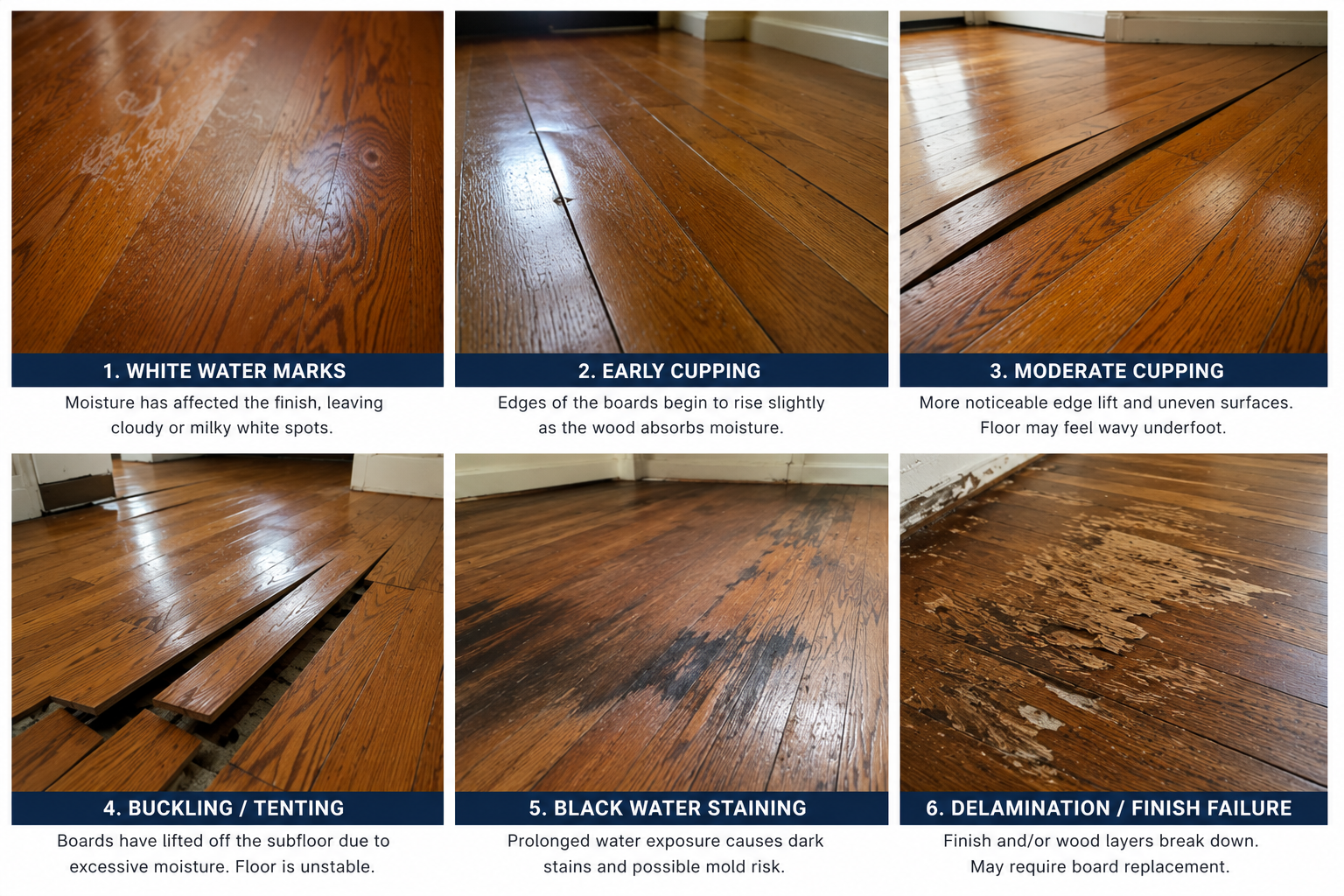
Understanding the Stages of Hardwood Floor Water Damage
Water damage rarely appears all at once. Most hardwood floors progress through several stages before major repairs become necessary.
Stage 1: White Water Marks and Finish Damage
White or cloudy areas often appear when moisture becomes trapped within the finish layer. At this stage, the wood itself may still be in good condition.
Common Causes
Wet mopping
Appliance condensation
Pet water bowls
Spilled liquids
High humidity
Typical Repair
Many floors in this stage can be restored through a professional screen and coat service or hardwood floor refinishing.
Stage 2: Early Cupping
Cupping occurs when the edges of hardwood boards rise slightly higher than the center. This is one of the earliest signs that moisture is affecting the wood itself.
Common Causes
Crawlspace moisture
Basement humidity
Small plumbing leaks
Seasonal moisture changes
Typical Repair
After the moisture source is corrected and the floor stabilizes, sanding and refinishing can often restore a flat, smooth appearance.
Stage 3: Moderate Cupping and Surface Distortion
As moisture exposure continues, cupping becomes more pronounced. Floors may develop a wavy appearance and feel uneven underfoot.
Common Causes
Long-term moisture exposure
Appliance leaks
Exterior water intrusion
Elevated indoor humidity
Typical Repair
Depending on the severity, restoration may involve moisture correction, sanding, refinishing, and selective board replacement.
Stage 4: Buckling and Raised Flooring
Buckling occurs when flooring begins lifting away from the subfloor. This is typically the result of significant moisture exposure.
Common Causes
Flooding
Burst pipes
Major appliance failures
Long-term water intrusion
Typical Repair
Buckled hardwood floors often require board replacement, tooth-in repairs, lace-in repairs, sanding, staining, and refinishing to restore a uniform appearance.
Stage 5: Black Water Stains
Black staining develops when moisture reacts with natural tannins in the wood. These stains often indicate prolonged exposure to water.
Common Causes
Refrigerator leaks
Plant pots
Pet urine
Slow plumbing leaks
Standing water
Typical Repair
Light staining may sand out during refinishing. Deep staining often requires hardwood floor board replacement combined with custom stain matching and blending techniques.
Stage 6: Delamination and Structural Damage
Engineered hardwood flooring may begin separating between layers. In severe cases, boards may swell, split, or lose structural integrity.
Common Causes
Flood damage
Long-term moisture exposure
Repeated water intrusion
Improper drying after water events
Typical Repair
Delaminated flooring often requires section replacement, board replacement, and refinishing to restore the floor.
Can Water-Damaged Hardwood Floors Be Repaired?
Many homeowners assume water-damaged hardwood floors must be replaced. In reality, a large percentage of hardwood floors can be restored when moisture problems are addressed early.
The success of a repair depends on:
Length of moisture exposure
Species of wood
Severity of cupping or buckling
Depth of staining
Condition of the subfloor
Whether the flooring is solid hardwood or engineered hardwood
The sooner water damage is addressed, the better the chances of preserving the original floor.
Common Hardwood Floor Water Damage Repairs
Depending on the condition of the floor, restoration may include:
Hardwood floor board replacement
Tooth-in repairs
Lace-in repairs
Water-damaged hardwood floor restoration
Hardwood floor sanding
Hardwood floor staining
Hardwood floor refinishing
Screen and coat services
Custom stain matching
Engineered hardwood floor repairs
Every floor is different. Some can be restored through sanding and refinishing alone, while others require extensive repair work before refinishing can begin.
Does Homeowners Insurance Cover Hardwood Floor Water Damage?
In some cases, homeowners insurance may help cover hardwood floor water damage caused by sudden events such as burst pipes, appliance failures, or accidental water discharge. Coverage varies by policy and cause of loss, so homeowners should consult their insurance provider regarding specific coverage details.
Hardwood Floor Water Damage Repair Service Area
Recoatings provides hardwood floor water damage repair throughout:
Erie, Boulder, Louisville, Lafayette, Superior, Longmont, Niwot, Gunbarrel, Broomfield, Westminster, Thornton, Northglenn, Brighton, Commerce City, Denver, and surrounding Front Range communities.
Frequently Asked Questions
Can water-damaged hardwood floors be saved?
Many can. The sooner moisture issues are addressed, the greater the chance of successful restoration.
Can cupped hardwood floors flatten back out?
In some cases, yes. Once moisture levels stabilize, slight cupping may improve naturally. More severe cases often require sanding and refinishing.
Do black water stains sand out?
Some do. Deep stains often require board replacement and color matching.
Can engineered hardwood be repaired after water damage?
Sometimes. The extent of damage determines whether restoration or replacement is the best option.
How much does hardwood floor water damage repair cost?
Costs vary based on the size of the damaged area, extent of repairs, board replacement requirements, and refinishing needs. Minor repairs may require limited restoration, while severe water damage can require extensive repair work.
Schedule a Hardwood Floor Evaluation
If your hardwood floors have developed white water marks, cupping, buckling, black staining, finish failure, delamination, pet damage, plumbing leak damage, appliance leak damage, or flood damage, a professional evaluation can determine whether restoration is possible.
Many hardwood floors that appear beyond repair can often be saved through proper hardwood floor restoration techniques, board replacement, sanding, staining, and refinishing.